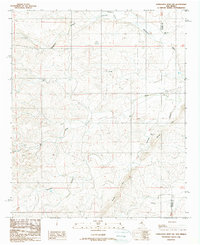
1988 Map of Horseshoe Bend NW
USGS Topo · Published 1989About this map
The high desert plains of the Lincoln County and Chaves County border are defined by a network of drainage systems and isolated water sources. This late-twentieth-century survey highlights a landscape where survival and land use were centered on remote outposts like Fifty-six Well, Pruett Well, and Louie Well. These named sites, often associated with specific families or local history, represent the critical infrastructure of the New Mexico ranching interior. The map reveals the intricate natural topography of the Pecos Valley region, showing how the land is carved by features such as Blackwater Canyon, Big Draw, and Tecolote Draw. Near the center, Border Hill rises as a significant landmark along the county line, while the southern reaches are marked by the winding path of Coyote Canyon. The scarcity of settlements and the prominence of these wells underscore the enduring importance of water rights and ranching boundaries in this part of the state.
Find a feature on this map
15 named features on this map. Tap any name to fly to it.
Don’t see what you’re looking for? This feature index may not catch every label — zoom into the map to look around manually.
Map Details
Editions of this 1988 Horseshoe Bend NW Map
This is the sole edition of this map. No revisions or reprints were ever made.
Other maps of this area
1936 · Arabela
USGS Topo · 1:48,000
1942 · Arabela
USGS Topo · 1:62,500
1955 · Roswell
USGS Topo · 1:250,000
1956 · Diamond A Ranch
USGS Topo · 1:24,000
1958 · Roswell
USGS Topo · 1:250,000
1959 · Diamond A Ranch
USGS Topo · 1:24,000
1961 · Tinnie
USGS Topo · 1:62,500
1962 · Roswell
USGS Topo · 1:250,000
1962 · Horseshoe Bend
USGS Topo · 1:62,500
1967 · White Flat SE
USGS Topo · 1:24,000