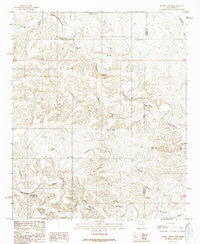
1988 Map of Skunk Canyon
USGS Topo · Published 1989About this map
Watering points define the landscape of the high desert along the border of Lincoln and Chaves Counties during the late 1980s. This arid terrain is marked by a network of isolated wells, such as Martin-Harold Well, Rattlesnake Well, and West Cherry Well, which supported ranching operations in a region characterized by deep relief and seasonal drainages. The topography is dominated by the complex systems of Skunk Canyon, Brushy Canyon, and Twin Butte Canyon, where the elevation changes are captured in 20-foot intervals. Smaller water features like Pond Lake and South Lake appear as rare catchments in the drainage basins. The presence of Buck Camp in the southeast corner suggest seasonal activity or livestock management near Buck Canyon Well. This provisional survey provides a precise look at the land's hydrology before modern developments, tracing a ranching infrastructure that relied heavily on these specifically named water sources.
Find a feature on this map
23 named features on this map. Tap any name to fly to it.
Don’t see what you’re looking for? This feature index may not catch every label — zoom into the map to look around manually.
Map Details
Editions of this 1988 Skunk Canyon Map
This is the sole edition of this map. No revisions or reprints were ever made.
Other maps of this area
1955 · Roswell
USGS Topo · 1:250,000
1956 · Diamond A Ranch
USGS Topo · 1:24,000
1958 · Roswell
USGS Topo · 1:250,000
1959 · Diamond A Ranch
USGS Topo · 1:24,000
1961 · Flying H
USGS Topo · 1:62,500
1961 · Indian Bluff
USGS Topo · 1:62,500
1961 · Tinnie
USGS Topo · 1:62,500
1962 · Roswell
USGS Topo · 1:250,000
1962 · Horseshoe Bend
USGS Topo · 1:62,500
1979 · Roswell
USGS Topo · 1:100,000