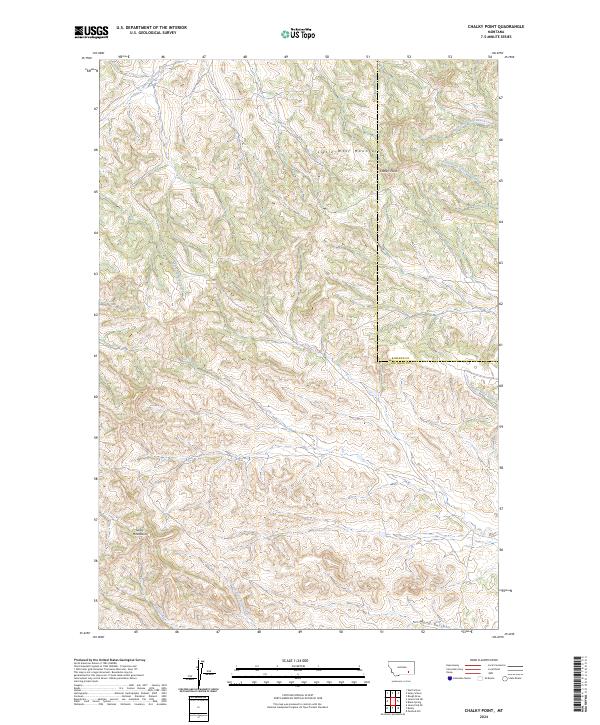
2024 Map of Chalky Point
USGS Topo · Published 2024About this map
The Little Wolf Mountains dominate this high-plains landscape where the Rosebud Co Big Horn Co line divides the terrain. This is a region defined by its complex drainage systems, where the headwaters of numerous creeks carve through the hills. To the north, the North Fork Cottonwood Creek and South Fork Cottonwood Creek flow eastward from the high ground near Chalky Point, while the southern reaches are marked by the Sarpy Mountains and the winding path of the North Fork Butte Creek. The lack of structural development reflects the isolation of this corner of Montana, where the primary identifiers are the natural landmarks used by generations of ranchers and travelers to navigate the broken country. The convergence of these seasonal and perennial waterways, such as Water Holes Creek and Bitter Creek, illustrates the critical role of water geography in this semi-arid environment.
Find a feature on this map
15 named features on this map. Tap any name to fly to it.
Don’t see what you’re looking for? This feature index may not catch every label — zoom into the map to look around manually.
Map Details
Editions of this 2024 Chalky Point Map
This is the sole edition of this map. No revisions or reprints were ever made.
Other maps of this area
1954 · Hardin
USGS Topo · 1:250,000
1957 · Hardin
USGS Topo · 1:250,000
1958 · Hardin
USGS Topo · 1:250,000
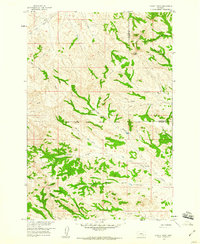
1958 · Chalky Point
USGS Topo · 1:24,000
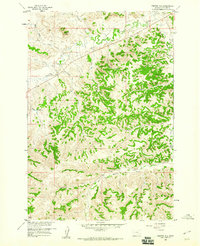
1958 · Painted Hill
USGS Topo · 1:24,000
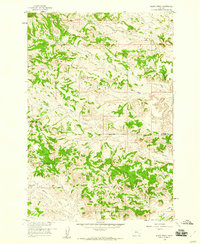
1958 · Black Spring
USGS Topo · 1:24,000
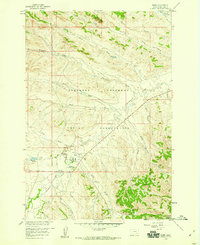
1958 · Busby
USGS Topo · 1:24,000
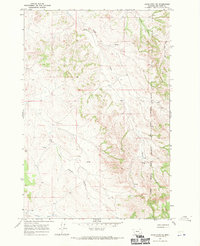
1967 · Jeans Fork NE
USGS Topo · 1:24,000
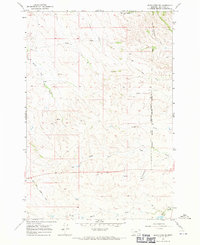
1967 · Jeans Fork SE
USGS Topo · 1:24,000
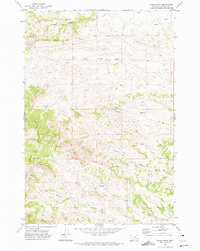
1971 · Rough Draw
USGS Topo · 1:24,000